Quick Takeaway
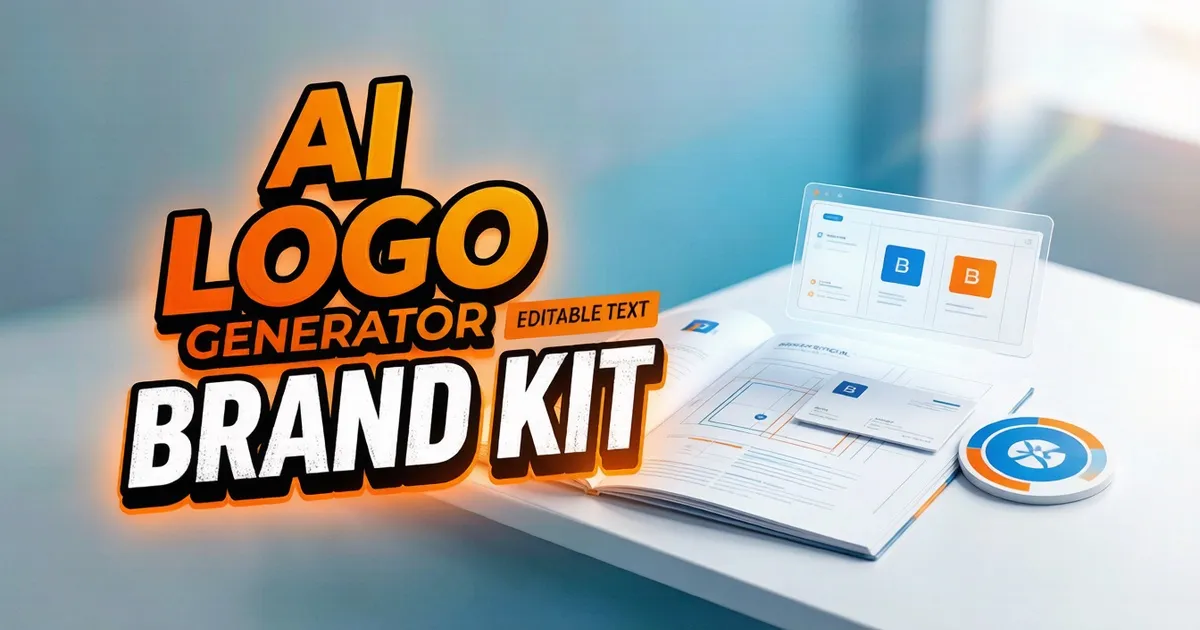
This article focuses on brand kits: comparing logos, social media templates, business cards, email signatures, website assets, and brand guidelines. It is designed for long-term brands, small businesses, and client projects. If you only look at the polished samples on an AI logo generator's homepage, it's easy to misjudge the tool's value. What truly determines whether a design is ready for launch is whether it can be edited, exported in the correct file formats, applied to real-world business scenarios, and backed by proper licensing and brand documentation.
Our goal is to help you decide when to purchase a brand kit. We break down the process using an evaluative approach rather than just listing tools. Think of this as an execution checklist: define your needs, select your tools, generate candidates, and finalize your choice based on formatting, adaptability, pricing, and risk assessment.
Decision Framework
| Stage | Action | Why It Matters |
|---|---|---|
| Step 1 | Define usage scenarios | Website nav, avatars, packaging, social media, and print have different file requirements |
| Step 2 | Test tools with the same brief | Avoid being misled by different sample styles |
| Step 3 | Check editing & export capabilities | Ability to change colors, fonts, layouts, and export SVG/transparent backgrounds affects long-term costs |
| Step 4 | Perform pre-launch risk checks | Commercial licensing, trademark similarity, and file archiving are non-negotiable |
AI logo tools offer speed, but speed shouldn't mean skipping due diligence. A logo that looks great on a generator page might not work as a 32px favicon, on a dark website header, as a circular social media avatar, on product packaging, or on printed business cards. Every time you evaluate a tool, replace the question "Can it generate this?" with "Can it deliver this?"
Evaluation Methods
1. Write a Brand Brief First
It doesn't need to be long, but it must be specific. Clearly state your brand name, industry, target audience, key touchpoints, desired vibe, preferred colors, and styles to avoid. For example, "modern" is too broad; if you specify "small business-oriented, friendly, clean, suitable for website nav and social avatars," the results will be much easier to filter.
2. Test Different Tools with the Same Requirements
Don't compare one tool's official showcase with another tool's random results. A fairer approach is to use the same brand name, industry, and keywords across multiple platforms, then compare default quality, editor flexibility, download formats, pricing tiers, and brand kit features. This leads to a more realistic selection.
3. Keep Only a Few Candidates
Generating dozens of images creates decision fatigue. We recommend keeping only 2-3 candidates per tool, then testing them in small sizes, black-and-white, on light/dark backgrounds, and in real-world mockups. If a candidate fails these tests, it isn't ready for finalization, no matter how good it looks in a large preview.
4. Make Files and Licensing Your Final Hurdle
Before official use, confirm you have access to transparent PNGs, SVGs or PDFs, horizontal and icon versions, dark and light variants, commercial usage rights, and proper purchase records. Being able to download a file doesn't guarantee trademark safety; for important brands, always perform a basic search and consult a professional if necessary.
Recommended Tool Path
For these tasks, prioritize testing: Looka, Zoviz, Tailor Brands, Turbologo, BrandCrowd, and LOGO.com. When choosing, don't just look at "generation quality"; enter the editor to check fonts, icons, colors, layouts, and export formats. All-in-one tools are great for quick starts, professional vector tools are better for design handoffs, brand kits are ideal for long-term operations, and free tools are best for early validation.
If your budget is tight, use free or low-cost tools to validate your direction first. Only pay for high-quality files, SVGs, transparent backgrounds, or full brand kits once you are ready to launch. This is safer than buying a full package upfront and avoids paying for directions that don't work out.
Common Pitfalls
Relying Only on the First Preview
Previews are usually shown in the most favorable environment, with optimized backgrounds, sizes, and lighting. In reality, your logo will appear on websites, avatars, product photos, email signatures, and printed materials. If it performs poorly in any key scenario, the design needs adjustment.
Misunderstanding "Free"
Free generation, free editing, free low-res downloads, free high-res downloads, and free commercial use are all different concepts. Many tools offer free previews, but require payment for SVGs, transparent backgrounds, high-res files, or brand kits. Check the specific terms before purchasing.
Ignoring Text and Typography
AI logos often struggle with wordmarks: inconsistent kerning, spelling errors, mismatched font styles, and messy capitalization. For a formal brand, you must treat text as a core asset—don't just look at the icon.
Confusing Commercial Licensing with Trademark Status
Tool licensing covers file usage rights, not trademark registration. Trademarks involve jurisdiction, industry categories, similarity, and actual usage. Long-term commercial brands should at least perform a basic search, and never skip professional advice for high-stakes projects.
Pre-Launch Checklist
- Brand name spelling, capitalization, and kerning have been manually checked.
- Logo remains legible at 32px, 64px, as a social avatar, and in website navigation.
- Transparent PNG, SVG or PDF, horizontal, icon, dark, and light versions are ready.
- Primary colors, secondary colors, font names, and usage restrictions are documented.
- Download packages, order records, licensing info, and pricing pages are saved.
- Basic trademark, domain, social media handle, and competitor similarity checks are complete.
- Final files have been previewed in real-world website or packaging mockups.
Final Advice
The core of a brand kit isn't just generating a "perfect" result in one go; it's about building a repeatable decision-making process. Use AI to expand your options, apply design common sense and business context to narrow them down, and finalize delivery with proper file formats, licensing records, and brand guidelines. For small teams, this is more reliable and easier to maintain long-term than simply chasing the "best-looking" logo.